Editorial Picks
Seven Han River parks for a slow afternoon
The Han River organises Seoul. These seven park districts are the ones the city actually uses — for cherry blossoms, fountain shows, picnic chimaek, summer pool days, and the long sunset light along the bank.
The Han River cuts Seoul into a northern and a southern half, and the riverbank itself is one of the longest continuous public-park systems in any major Asian capital — eleven distinct park districts running roughly forty kilometres from Gangseo in the west to Gwangnaru in the east. For an international visitor, choosing where to walk along the Han River matters more than first appears: the parks have meaningfully different temperaments, different signature events, and different reading depending on the season. Yeouido is the cherry-blossom and fireworks-festival park; Banpo is the rainbow-fountain park; Ttukseom holds the J-Bug observatory and the summer outdoor pool; Mangwon is the fashionable picnic park favoured by people in their twenties and thirties; Nanji is the only park with public camping. The Seoul Metropolitan Government's Hangang Park English portal is the authoritative reference for events and facility hours, and VisitKorea's Han River guide is the standard English-language overview. What follows below is editorial — what the parks are actually known for, how the seasons sit on them, and how to choose between them for a single Seoul afternoon. We do not number these in ranking order; the alphabetical Featured A-G structure reflects editorial neutrality across parks operating at different scales and for different audiences.
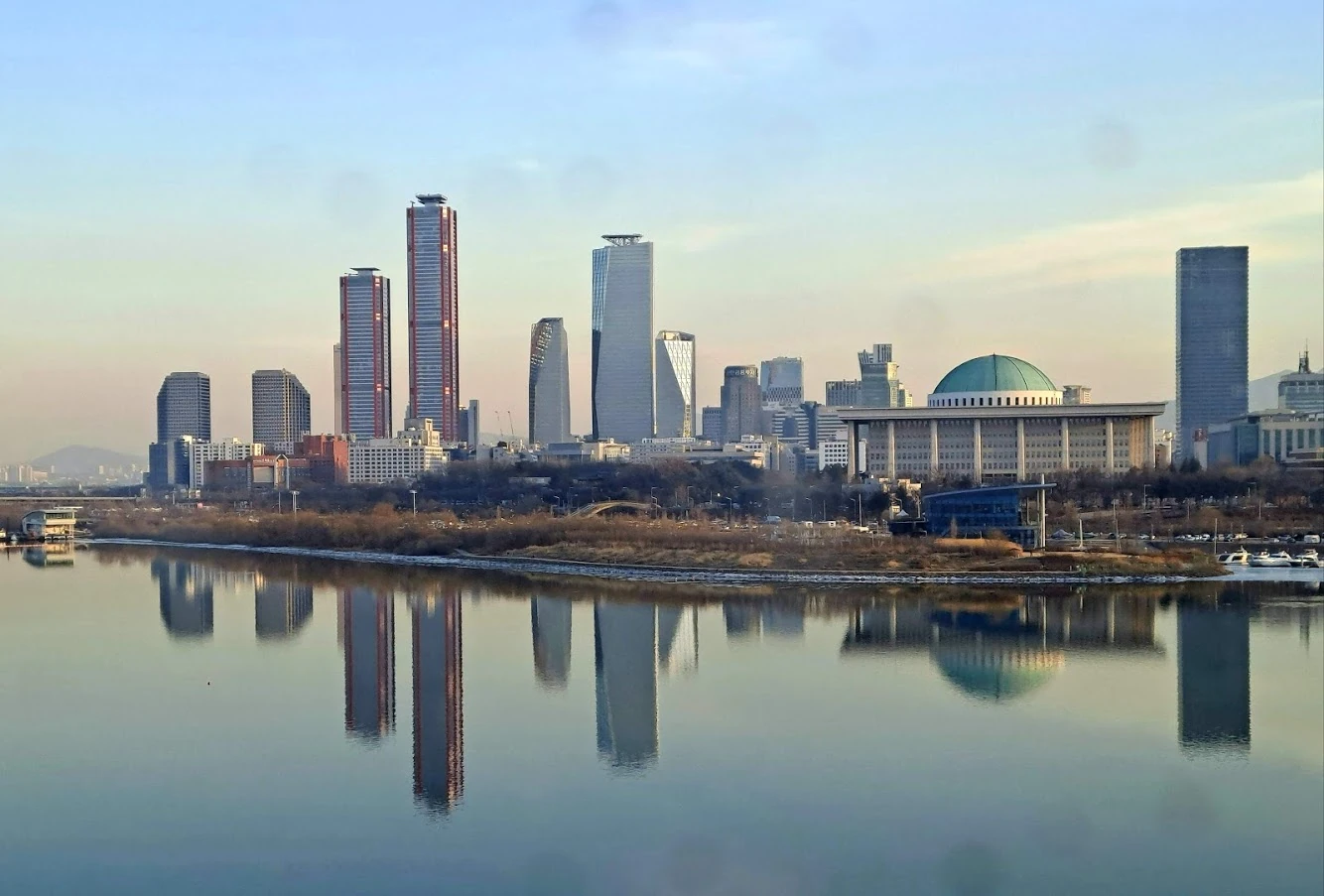
Featured A — Yeouido Hangang Park (Yeongdeungpo-gu)
Yeouido is the most iconic of the eleven Han River parks and the one that most international visitors are pointed toward by default. The district sits along the southern bank in Yeongdeungpo-gu, wrapping the western and southern edges of Yeouido island — Seoul's financial-services cluster. Two things make Yeouido the headline park. First, the cherry-blossom corridor along Yunjung-no behind the National Assembly building, which holds one of the densest concentrations of cherry trees in central Seoul and runs an officially-programmed Yeouido Spring Flower Festival in early April. Second, the annual Seoul International Fireworks Festival in early October, which uses the riverbank between Yeouido and Banpo as the viewing line and draws a million people across a single weekend. Outside those two peak windows, Yeouido is open twenty-four hours with free entry and bike rental running KRW 3,000 to 5,000 per hour. The park reads denser and more event-organised than the other Han River districts; for visitors arriving in cherry-blossom season or in early autumn, it is the right default. Outside those windows, Banpo across the river holds the more distinctive signature.
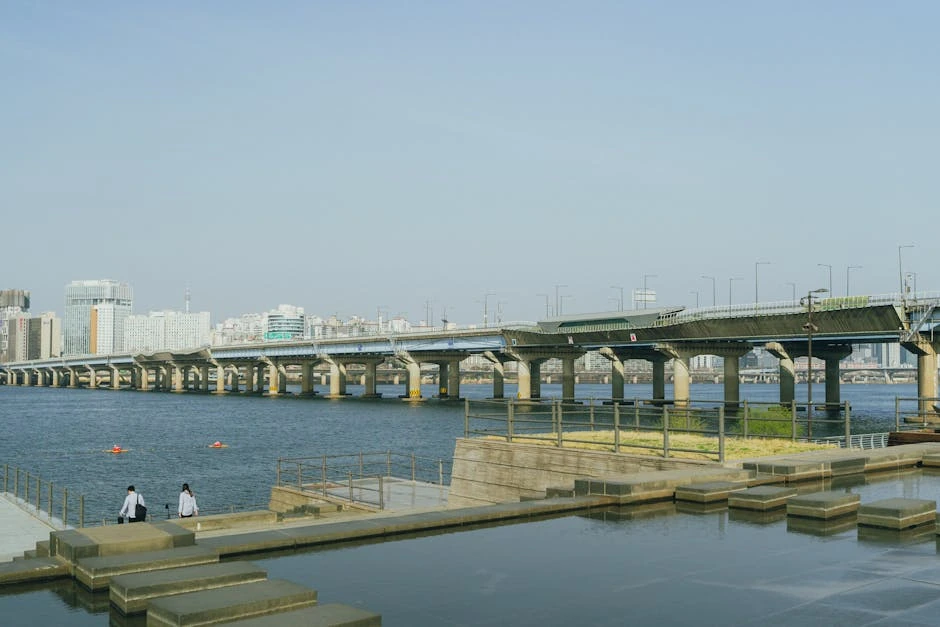
Featured B — Banpo Hangang Park (Seocho-gu)
Banpo is the rainbow-fountain park. The district sits along the southern bank in Seocho-gu, immediately south of Banpo Bridge, and is built around the Moonlight Rainbow Fountain — a 1,140-metre installation running the full length of Banpo Bridge and recognised by Guinness World Records as the longest bridge fountain in the world. The fountain operates seasonally from April through October with multiple twenty-minute shows per evening, typically starting at 19:30 and running through 21:30. The Banpo bank is the photography location for the fountain — the Moonlight Rainbow Square and the Some Sevit floating-island pavilions sit directly under the show line — and is the single most photographed Han River segment. The park is free, open twenty-four hours, and is the natural pairing with the Express Bus Terminal subway and shopping cluster directly behind it. Outside fountain season, Banpo holds a quieter character with strong jogging and bike-path infrastructure. For visitors with one evening on the Han River and any month between April and October, Banpo is the right choice.
Featured C — Ttukseom Hangang Park (Gwangjin-gu)
Ttukseom sits along the northern bank in Gwangjin-gu, around the Jayang-dong neighbourhood and the Konkuk University and Children's Grand Park area. The district reads younger than Yeouido or Ichon — Konkuk University students and graduates in their twenties dominate the park on weekends, and the J-Bug (Jayang-dong Bug) observation deck is the architectural landmark, an organic blue-glass structure cantilevered over the river. Ttukseom holds the largest of the summer outdoor swimming pools in the Han River park system, open from late June through mid-August with admission running KRW 5,000. The park is the standard Han River entry point for international visitors staying in Gangnam-gu or the eastern central districts who want a younger and more casual scene than Yeouido. Open twenty-four hours, free outside the summer pool. The combination of the J-Bug, the pool, and the proximity to Konkuk University food clusters makes Ttukseom the strongest single-afternoon Han River choice for visitors in their twenties and early thirties.
Featured D — Ichon Hangang Park (Yongsan-gu)
Ichon is the family-friendly Han River park. The district sits along the northern bank in Yongsan-gu, around Ichon-dong and the southern edge of the Yongsan central-international district, and is built around an ecological zone with restored wetlands and a wider band of greenery than the more urbanised park districts. The park is the closest Han River park to the National Museum of Korea — twenty minutes walking via the Hangang underpass — which makes Ichon the natural pairing with a museum-day itinerary. The bike path along the Ichon segment is one of the better-graded sections for casual cyclists with children, and the park reads quieter on weekends than Yeouido or Mangwon. Free entry, open twenty-four hours. Ichon is the right Han River choice for visitors travelling with younger children, for visitors basing themselves in Yongsan or the central-international hotel cluster, or for visitors specifically combining a museum visit with a riverbank afternoon. The park does not hold a signature event in the way Yeouido and Banpo do; the strength is the consistency of the everyday experience.
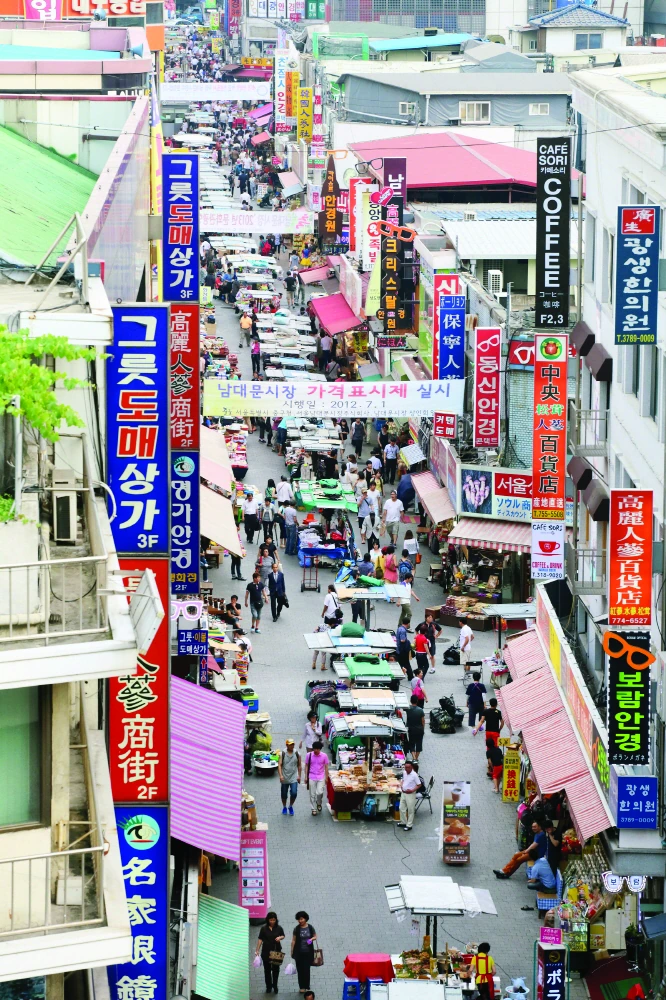
Featured E — Mangwon Hangang Park (Mapo-gu)
Mangwon is the most fashionable of the Han River parks among Seoul residents in their twenties and thirties. The district sits along the northern bank in Mapo-gu, around the Mangwon-dong neighbourhood, and is the standard weekend picnic destination for the Mapo and Hongdae cluster. The park is the strongest single park for ramen-and-chimaek picnics — instant ramen heated at the park-side convenience stores, fried chicken and beer delivered to the picnic mat — and is the park most regularly featured in Korean Z-generation lifestyle press as the Han River default. Mangwon Market sits one block north of the park entrance and is the standard pre-park stop for street food. The Banpo Bridge fountain is visible from the eastern edge of Mangwon Park, which gives the district a secondary photography line during fountain season. The park is free, open twenty-four hours, with bike rental available. For visitors basing themselves in Hongdae, Mapo, or the western-central districts, and for visitors specifically looking for the everyday Seoul riverbank scene rather than the headline event-organised park, Mangwon is the right choice.
Featured F — Jamsil Hangang Park (Songpa-gu)
Jamsil sits along the southern bank in Songpa-gu, around the Jamsil-dong neighbourhood, and is built directly opposite Lotte World Tower — Korea's tallest building, completed in 2017 at 555 metres. The park is the single best photography position for Lotte World Tower from a riverbank context, with the tower rising directly above the park's western edge and reflecting in the river on still days. The district also operates one of the Han River park system's summer outdoor swimming pools, with admission running KRW 5,000 from late June through mid-August. Olympic Park sits one subway stop south, which makes Jamsil the natural pairing with a Lotte World theme-park-and-tower-and-river itinerary for visitors based in the Gangnam-Songpa cluster. Free park entry, twenty-four hours. The park reads denser than Ichon but quieter than Yeouido; the strength is the Lotte World Tower architectural backdrop, and the natural visitor itinerary integrates the tower observation deck, Lotte World Mall, and the riverbank into a single afternoon.
Featured G — Nanji Hangang Park (Mapo-gu)
Nanji is the only Han River park with public camping, and the only park converted from a former landfill site. The district sits along the northern bank in Mapo-gu, around the Sangam neighbourhood, and was built on the rehabilitated Nanjido waste-disposal site through a long-running ecological restoration programme that began in the late 1990s. The park is now Seoul's largest single-park camping site, with reservable camp pitches running KRW 7,000 to 10,000 per night through the Hangang Park reservation system. The park is also pet-friendly — one of only two parks in the Han River system that permits dogs off-lead in dedicated zones. Haneul (Sky) Park, a separate park at the top of the rehabilitated hill, sits directly above Nanji and is the standard sunset photography position for the broader Sangam district. The combination of camping, the Sky Park sunset, and the World Cup Stadium one subway stop away makes Nanji the right Han River park for visitors specifically interested in an overnight outdoor experience rather than a single-afternoon park visit. For day-trip purposes, the other six parks on this list typically read more directly.
Safety, etiquette, and what locals expect of visitors on the riverbank
The Han River parks are well-policed public spaces with strong baseline safety; the editorial board's note for international visitors is more about etiquette than about caution. The parks are open twenty-four hours and remain reasonably safe through the night, with regular police patrols, well-lit main paths along the riverbank, and a substantial late-evening population at Mangwon, Banpo, and Yeouido on weekends. Visitors travelling alone should keep to the main lit paths after midnight and stay on the riverbank-side path rather than the upper park-edge zones. Single-occupant tents on the public lawns are not permitted outside the designated Nanji camping zone; smaller open-air picnic mats and pop-up sunshades are the standard format and are widely seen. Alcohol consumption on the riverbank is legal and culturally normalised — chimaek picnics with beer are the everyday default at Mangwon — but visible intoxication and disruptive behaviour are not tolerated and the police will move groups along. Open fires and barbecues are not permitted on the lawns except at the designated Nanji camping pitches; portable gas stoves on the picnic mats are also widely discouraged outside the camping zone. Litter discipline is taken seriously; the parks operate clearly marked recycling stations, and the social expectation is that picnic groups carry out everything they carry in. Smoking is permitted only at designated smoking zones, which are sparsely distributed across the park district. Swimming in the Han River itself is not permitted; the river is a major commercial-traffic waterway and the current is strong. The outdoor pools at Ttukseom, Jamsil, and several smaller parks are the appropriate alternative during summer. Drone flying is restricted across most of the central-Seoul Han River park zones due to proximity to the presidential complex, the National Assembly, and major military installations; visitors planning drone photography should reference the official Seoul drone-flight permission system in advance. Pet etiquette is more relaxed at Nanji's off-lead zone than elsewhere; the other parks expect dogs on lead on the public paths.
How to choose between the seven — a working orientation
For visitors with one Han River afternoon in Seoul, the editorial board's working orientation reads as follows. If the visit falls in early April, Yeouido is the only sensible default — the cherry-blossom corridor along Yunjung-no is one of the densest in Asia, and missing the bloom for a different park is a structural mistake on the trip. If the visit falls in early October, Yeouido again becomes the default because of the Seoul International Fireworks Festival. For any evening between April and October that is not a Yeouido peak weekend, Banpo holds the strongest signature — the Moonlight Rainbow Fountain runs roughly four shows per evening and reads at its best from the Banpo bank rather than from any other riverbank vantage. For a summer afternoon specifically built around swimming, Ttukseom holds the largest of the Han River outdoor pools and the strongest younger crowd; Jamsil is the parallel choice for visitors based in the Gangnam-Songpa cluster. For a fashionable picnic afternoon in the Mapo-Hongdae register — instant ramen, fried chicken, beer, bare feet on the grass — Mangwon is the right park, with the additional advantage of Mangwon Market one block north for street food. For a quiet park afternoon with younger children, Ichon reads the most family-friendly, with the additional advantage of National Museum of Korea pairing. For a single Han River afternoon that is also a Lotte World Tower photography afternoon, Jamsil sits directly across the river from the tower. For an overnight camping experience, Nanji is the only Han River option. Visitors with two Han River afternoons across the trip can naturally pair Yeouido or Banpo (south bank, headline events) with Mangwon or Ichon (north bank, everyday scene), or pair an afternoon park visit with an evening fountain-show visit at Banpo. The bike-path system connects all seven parks; a rented bike from Yeouido to Banpo runs roughly 4 kilometres along the south bank and can be ridden in either direction.
Seasonal calendar — how the seven parks read across the year
The Han River park year organises into four meaningful seasons for visitors. Spring (mid-March through May) is dominated by the cherry-blossom window — typically first to second week of April, peak bloom — and centres on Yeouido. The cherry-blossom corridor along Yunjung-no runs roughly 1.7 kilometres behind the National Assembly building, and the Yeouido Spring Flower Festival closes the road to vehicle traffic during the festival weekend. Mangwon, Banpo, and Ichon also hold meaningful cherry-blossom stretches, but Yeouido is the headline. Late spring through early summer adds the seasonal opening of the Banpo Moonlight Rainbow Fountain, which begins in April and runs through October. Summer (June through August) opens the outdoor swimming pools at Ttukseom and Jamsil — and at several smaller park districts — with the season running from late June through mid-August. Summer is also the peak picnic season; Mangwon and Yeouido carry the highest weekend density. Autumn (September through early November) brings the cooler walking weather and the Seoul International Fireworks Festival in early October at Yeouido, which is the single largest annual event on the riverbank and draws over a million people across one weekend. Autumn foliage runs late October through mid-November and reads most strongly at Ichon, Banpo, and the Sky Park above Nanji. Winter (December through February) closes the fountain, the pools, and the camping pitches but keeps the parks open as walking and ice-skating zones; Yeouido and Banpo both operate small seasonal ice rinks. International visitors planning a Han River afternoon should reference the live Hangang Park English portal for current-cycle event windows; the calendar shifts year by year with weather and with the official festival programming.
Practical logistics — access, bike rental, food, restroom infrastructure
Practical logistics across the seven Han River parks are consistent in their fundamentals and meaningfully different in their details. Subway access is the standard route. Yeouido is reached from Yeouinaru Station (Line 5) or Yeouido Station (Line 5/9); Banpo from Express Bus Terminal Station (Line 3/7/9) or Sinbanpo Station (Line 9); Ttukseom from Ttukseom Resort Station (Line 7); Ichon from Ichon Station (Line 4/Jungang); Mangwon from Mangwon Station (Line 6); Jamsil from Jamsil Station (Line 2/8); Nanji from World Cup Stadium Station (Line 6). All seven parks sit within a fifteen-minute walk of the subway exit. Taxi access is universal. Bike rental at Yeouido, Banpo, Mangwon, and Jamsil runs KRW 3,000 to 5,000 per hour through official park kiosks; KakaoT Bike (a dockless bike-share system) and Seoul Public Bike (the city's docked bike-share programme) also operate across the riverbank, with the Seoul Public Bike daily pass at KRW 1,000 generally the best value for casual riders. Food at the parks runs three registers: convenience-store ramen (heated at the in-park store, the standard everyday choice, KRW 3,000-5,000), park-side food kiosks (the Banpo Some Sevit floating-island pavilions and the Yeouido Marina cluster, mid-tier sit-down dining), and delivery (the apps Coupang Eats, Yogiyo, and Baemin all deliver to standard park pickup points; this is the standard route for chimaek picnics at Mangwon). Restroom infrastructure is solid across the seven parks; the parks are public and free, restrooms are accessible without purchase. Accessible-restroom and stroller-friendly path coverage is strongest at Ichon, Yeouido, and Jamsil. Pet policy varies: Nanji holds the largest off-lead area; the other parks permit dogs on lead on the public paths. The riverbank parks are open year-round, twenty-four hours; specific facility hours (pools, camping pitches, fountain shows, bike kiosks) follow the seasonal calendar.
Picnic gear, food sourcing, and what to bring for a slow afternoon
A Han River picnic afternoon in Seoul runs on a fairly standardised set of equipment and a small number of food-sourcing options that locals use without much variation. The picnic mat itself is the structural piece of gear; oversized waterproof mats are sold at every convenience-store chain in Seoul (CU, GS25, 7-Eleven, Emart 24) for KRW 5,000 to 15,000 and are designed exactly for this use case. Daiso — the budget homewares chain present in most central-Seoul neighbourhoods — sells the broader picnic kit (mats, foldable tables, small chairs, parasols) at the most accessible price points. For visitors arriving without gear, the most direct route is to buy a mat at a convenience store on the way to the park; the major Han River parks all have at least three convenience-store branches within a short walking radius. Food sourcing at the parks runs three routes that locals freely mix. The convenience-store route — boil-in-bag ramen heated in the in-store kettles, kimbap rolls, triangular gimbap (samgak gimbap), sausages, snacks, drinks — is the everyday default and runs roughly KRW 10,000 to 20,000 per person for a full picnic. The delivery route — fried chicken and pizza via Coupang Eats, Yogiyo, or Baemin to a designated pickup point at the park edge — is the standard chimaek picnic structure and runs roughly KRW 25,000 to 40,000 per person inclusive of beer. The market-and-bring route — pre-park sourcing at Mangwon Market, Tongin Market, or Gwangjang Market and carrying food in — is the most distinctive option and is the strongest expression of the local picnic culture. Drinks are widely available at convenience stores; beer is the standard picnic drink, with makgeolli (Korean rice wine) the traditional alternative and a wider craft-beer selection available at the larger convenience-store branches. Plastic and paper cups are stocked at every convenience store. Glass bottles are discouraged at the parks. Garbage bags are the user's responsibility; the parks operate clearly marked recycling stations, and the social expectation is to carry out everything carried in. A small sunshade or umbrella is useful in summer; the parks are largely open lawn with limited shade. For evening visits in spring, autumn, and winter, a light jacket and a small picnic blanket meaningfully improve the experience as the river temperature drops earlier than the city temperature.
Editorial method — what is on this list and how to read it
The list above includes seven of the eleven Han River park districts maintained by the Seoul Metropolitan Government. The four districts not included on this list — Gangseo, Yanghwa, Gwangnaru, and Jamwon — are excellent parks but read more locally and less for international visitors planning a single Han River afternoon. The seven on this list are the parks that consistently appear on Seoul tourism press, on VisitKorea's English-language Han River guides, and on the Seoul Metropolitan Government's English-language event calendar. Park hours are twenty-four hours for general access; specific facilities (swimming pools, camping pitches, bike rental kiosks, ferry docks) have their own posted hours and seasonal calendars. Free entry applies across the system; facility-specific fees range from KRW 3,000 (bike rental per hour) to KRW 10,000 (camping pitch per night). Cherry-blossom timing varies between late March and mid-April depending on the year; the fireworks festival and Moonlight Rainbow Fountain operate on published calendars. International visitors should reconfirm event windows on the Hangang Park English portal at the time of trip planning. The Han River parks are public infrastructure; we maintain no commercial relationships with any park-related vendor and have no incentive to list any park other than as it reads.
“The Han River organises Seoul. Which park you walk along on which afternoon shapes the day more than first appears. — Gangnam Meditour Editorial Board”
Frequently asked questions
Which Han River park is best for cherry blossoms in April?
Yeouido Hangang Park in Yeongdeungpo-gu holds the cherry-blossom corridor along Yunjung-no behind the National Assembly building and runs the officially-programmed Yeouido Spring Flower Festival in early April. The corridor is the densest cherry-blossom segment in central Seoul. Peak bloom typically falls between the first and second week of April, varying with the year's spring temperatures.
When does the Banpo Bridge Moonlight Rainbow Fountain run?
The fountain runs seasonally from April through October, with multiple twenty-minute shows per evening typically starting at 19:30 and ending by 21:30. The fountain is recognised by Guinness World Records as the longest bridge fountain in the world at 1,140 metres. Banpo Hangang Park is the standard viewing position; Mangwon Hangang Park offers a secondary distant view.
Can I swim at the Han River parks in summer?
Yes, at the outdoor pools — not in the river itself. Ttukseom and Jamsil Hangang Parks operate the largest of the summer outdoor swimming pools from late June through mid-August, with admission at KRW 5,000. Several other parks operate smaller pools on the same calendar. Open-water swimming in the Han River is not permitted.
Which Han River park is best for a picnic with chimaek?
Mangwon Hangang Park in Mapo-gu is the standard chimaek-picnic destination, with Mangwon Market one block north for pre-park street food and convenience-store ramen widely available at the park edge. The park reads as Seoul's most fashionable riverbank picnic spot among residents in their twenties and thirties.
Where do locals camp along the Han River?
Nanji Hangang Park in Mapo-gu is the only Han River park with public camping. Pitches run KRW 7,000 to 10,000 per night and are reservable through the Hangang Park reservation system. Nanji is built on a rehabilitated former landfill and is the largest single-park camping site in Seoul.
How much does bike rental cost at the Han River parks?
Bike rental at the Han River parks typically runs KRW 3,000 to 5,000 per hour through the official park bike kiosks. Yeouido, Banpo, Mangwon, and Jamsil all operate bike rental. The riverside bike path system is over forty kilometres long and connects all eleven Han River park districts.
Which Han River park is best for visitors travelling with children?
Ichon Hangang Park in Yongsan-gu reads as the most family-friendly park, with restored ecological wetlands, gentler bike paths, and a quieter weekend rhythm than Yeouido or Mangwon. The park is also the closest Han River park to the National Museum of Korea, which gives it a natural museum-and-riverbank itinerary.
What is the best Han River park for a Lotte World Tower photo?
Jamsil Hangang Park in Songpa-gu sits directly opposite Lotte World Tower — Korea's tallest building at 555 metres — and is the standard riverbank photography position for the tower. The reflection on the river is strongest in the early morning and on still days; sunset behind the tower also reads well from the park's western edge.