Treatment Guide
Korea medical tourism — pricing reference
KRW figures with USD, CNY, and JPY conversions for the major aesthetic and regenerative platforms, by region.
Pricing transparency is a baseline editorial requirement on Gangnam Meditour and a baseline expectation patients should hold of any Korean clinic they consider. The references on this page are sourced from public clinic price lists at the time of last review (currently 2026-05-10), updated quarterly, and presented in KRW with conversions to USD, CNY (¥), and JPY (¥) at the prevailing rate. The figures are orientation, not quotations: actual pricing at consultation may differ depending on the protocol the senior physician proposes, the shot or session count adjusted to your anatomy, and any combination-treatment package arrangement. We do not publish prices a clinic has not itself published; we do not synthesise prices across clinics into composite figures that misrepresent any individual clinic's actual price; we do not extrapolate prices from one region to another. Where a treatment platform has substantial cross-region variation, we report ranges and indicate where each band is typical. For broader context on how price relates to clinic positioning rather than platform authenticity, see our editorial policy and the relevant treatment guides.
How currency conversion is calculated here
All prices are sourced as KRW figures from public clinic price lists. USD, CNY, and JPY conversions on this page are calculated at approximate rates of 1 USD = 1,300 KRW, 1 CNY = 180 KRW, and 1 JPY = 8.7 KRW (rates as of 2026-05-10; exact rates fluctuate daily). The conversions are presented for orientation; patients should verify current exchange rates and consider that credit-card transaction rates often run 2-3% above mid-market for international point-of-sale. Korean clinics typically accept Korean credit cards and major international cards (Visa, Mastercard, Amex); some smaller clinics prefer Korean Won cash for full payment. International wire transfer is occasionally arranged for larger packages. Currency conversion at clinic point-of-sale (DCC — Dynamic Currency Conversion) is generally less favourable than home-currency conversion through your card issuer; declining DCC and accepting the KRW charge typically saves 2-4%.
Ultherapy PRIME — Korean pricing range
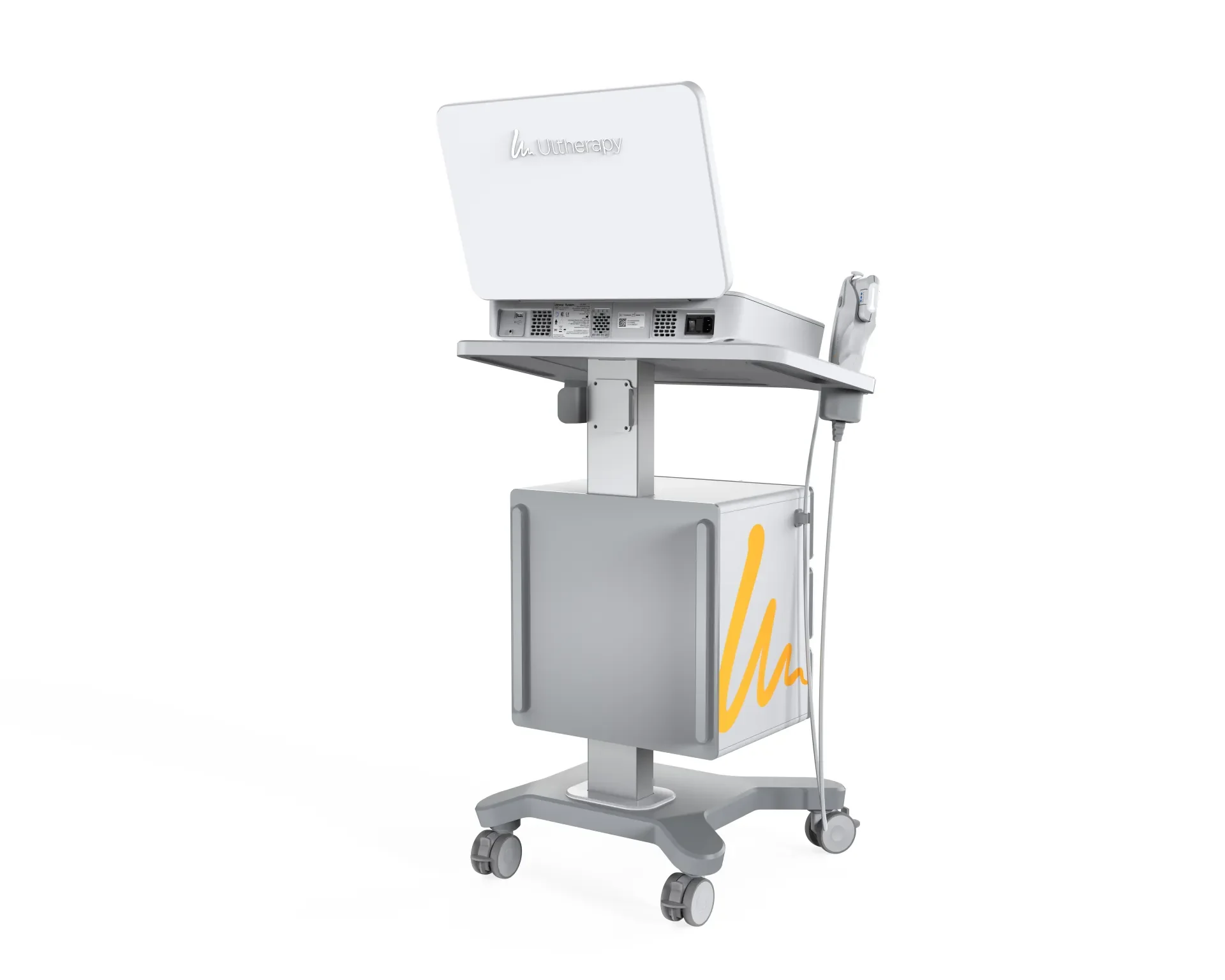
Ultherapy PRIME pricing in Korea typically ranges from KRW 1,500,000 to KRW 4,500,000 for face-and-neck protocols, with face-neck-décolleté protocols at the higher end. Myeongdong mid-tier clinics often run KRW 1,500,000-2,800,000 (~USD 1,150-2,150 / CNY 8,300-15,500 / JPY 172,000-322,000). Gangnam premium clinics often run KRW 2,800,000-4,500,000 (~USD 2,150-3,460 / CNY 15,500-25,000 / JPY 322,000-517,000). Incheon Airport-region pricing varies more widely depending on whether the clinic is a Seoul-flagship branch (parent pricing) or a standalone airport practice. The price difference reflects shot count, physician seniority, multilingual support depth, and clinic positioning rather than platform authenticity — all authorised Ultherapy PRIME providers operate the same Merz Aesthetics device, verifiable through the Merz provider locator.
Thermage FLX — Korean pricing range
Thermage FLX pricing in Korea typically ranges from KRW 1,800,000 to KRW 4,500,000 for face protocols, with face-and-neck protocols at the higher end and full face-neck-eye protocols (with Eyes Total Tip) approaching KRW 6,000,000. Myeongdong mid-tier clinics often run KRW 1,800,000-3,000,000 (~USD 1,380-2,300 / CNY 10,000-16,700 / JPY 207,000-345,000). Gangnam premium clinics often run KRW 3,000,000-4,500,000 (~USD 2,300-3,460 / CNY 16,700-25,000 / JPY 345,000-517,000). Combined Thermage-and-Ultherapy programmes (sequenced across two visits) commonly run KRW 5,000,000-8,000,000 total. Pricing reflects shot count, physician seniority, and clinic positioning rather than platform authenticity — all authorised Thermage FLX providers operate the same Solta Medical device.
Sofwave and regenerative work — Korean pricing range
Sofwave pricing in Korea typically ranges from KRW 1,200,000 to KRW 3,500,000 for face protocols. Myeongdong: KRW 1,200,000-2,200,000 (~USD 920-1,690 / CNY 6,700-12,200 / JPY 138,000-253,000). Gangnam: KRW 2,200,000-3,500,000 (~USD 1,690-2,690 / CNY 12,200-19,400 / JPY 253,000-402,000). Regenerative bio-active work — exosome, growth-factor, or conditioned-media protocols delivered via microneedling or RF-assisted micro-channelling — typically runs KRW 400,000-1,500,000 per session, with three-to-five-session programmes commonly KRW 1,500,000-5,000,000 total. The wide range reflects substantial variation in the active (single growth factor versus comprehensive exosome cocktail), the delivery (basic microneedling versus RF-assisted micro-channelling), and clinic positioning. Pricing structure should be quoted in writing before booking.
Thread lifting and combination programmes
Thread-lift pricing in Korea typically ranges from KRW 1,500,000 to KRW 6,000,000+ depending on thread count, polymer selection (PDO is least expensive, PCL and PLLA more), and clinic positioning. PDO-only protocols often run KRW 1,500,000-2,500,000 (~USD 1,150-1,920); mixed PDO-PCL or PDO-PLLA protocols KRW 3,000,000-5,000,000; comprehensive multi-vector premium protocols KRW 5,000,000-7,000,000+. Combination programmes spanning Ultherapy PRIME plus Thermage FLX plus regenerative work plus thread lifting run KRW 8,000,000-15,000,000+ across a 5-to-7-day Seoul trip; the package pricing is sometimes negotiable in writing before booking and reflects the comprehensive nature of the programme rather than discount on individual modalities. International patients should request itemised pricing for each component before committing to a package, and should compare against the standalone-modality references above. The aftercare guide covers the post-procedure window and follow-up considerations across modalities.
Frequently asked questions
Are these prices what I will actually pay at consultation?
The references on this page are orientation, not quotations. Actual pricing at consultation depends on the protocol the senior physician proposes — shot or session count adjusted to your anatomy, polymer selection in thread protocols, combination-treatment arrangement. Always confirm pricing in writing before booking.
Why does Korean pricing vary so widely between clinics?
The variance reflects shot count, physician seniority, multilingual support depth, aftercare structure, and clinic positioning rather than platform authenticity — authorised platform providers operate the same manufacturer device. The honest read is that you are paying for consultation depth and aftercare structure as much as for the treatment itself.
Are Korean prices negotiable?
Premium-tier clinics in Cheongdam and Apgujeong typically operate published-price-list models without significant negotiation. Mid-tier Myeongdong and combination-package programmes have somewhat more flexibility. Always request written pricing; verbal quotations are not enforceable in Korean clinical practice.
How do Korean prices compare with other markets?
Korean prices for branded ultrasound and radiofrequency platforms are typically 30-60% below comparable treatment in Hong Kong or Singapore, 50-70% below the United States or United Kingdom, and broadly comparable to Japan. The difference is partly cost structure (lower physician overhead, lower real-estate cost), partly market competition (Korea has high clinic density).
What payment methods do Korean clinics accept?
Most Korean clinics accept major international cards (Visa, Mastercard, Amex) for full payment. Korean credit cards are universally accepted. Cash (Korean Won) is accepted at smaller clinics; some clinics offer 2-5% cash discount for in-person KRW payment. International wire transfer is occasionally used for larger combination packages, typically with deposit at booking.
Should I accept Dynamic Currency Conversion at point of sale?
Generally no. DCC offered by Korean point-of-sale terminals typically converts at 2-4% above mid-market rate; declining DCC and accepting the KRW charge lets your card issuer convert at home-currency rates that are usually more favourable. Always ask the clinic to charge in KRW.