Treatment Guide
Cross-treatment cost matrix — Korea aesthetic and regenerative work
Side-by-side KRW figures for the five major platforms, converted into USD, EUR, JPY, and CNY for the international patient.
The cost question is rarely a single-modality question. International patients arriving in Seoul for an aesthetic consultation typically leave with a programme that touches two or three platforms — an ultrasound or radiofrequency tightening device, a regenerative bio-active protocol layered into the recovery window, sometimes a thread-lift vector to support the lower face, and increasingly a stem-cell-derived conditioned-media or exosome series scheduled across the trip. The total cost of such a programme is a different number from the headline price of any single device, and the cross-treatment comparison is where most planning errors happen. This page presents the five major platforms as a side-by-side matrix in Korean Won, with conversions into United States Dollars, Euros, Japanese Yen, and Chinese Yuan at the prevailing rate of last review (2026-05-10). The figures are orientation, not quotations: actual pricing at consultation may differ depending on the protocol the senior physician proposes, the shot or session count adjusted to your anatomy, and any combination-treatment package arrangement. For the operational mechanics of currency conversion at point-of-sale, see the pricing guide. For platform-specific protocol detail, follow the platform anchor links throughout this page and the broader treatments overview. For the broader market context that situates this matrix in the 2026 Korean aesthetic landscape, see the parallel 2026 market trends piece and the Visit Korea Medical regional comparison hub.
Currency conversion methodology and the international payment context
All figures on this page originate as Korean Won amounts sourced from publicly published clinic price lists at the time of last review. The USD, EUR, JPY, and CNY conversions are calculated at approximate rates of 1 USD = 1,300 KRW, 1 EUR = 1,410 KRW, 1 JPY = 8.7 KRW, and 1 CNY = 180 KRW, current as of the publication date. Exchange rates fluctuate daily; the conversions are presented for orientation and should be re-verified against current mid-market rates before booking. International patients should be aware of three operational realities. First, credit-card point-of-sale conversion in Korea typically runs 2-4% above mid-market — Dynamic Currency Conversion offered by Korean terminals is generally less favourable than home-currency conversion through the card issuer, and declining DCC is usually the preferred move. Second, most Korean clinics accept Visa, Mastercard, and American Express, with some smaller practices preferring Korean Won cash and offering small cash discounts of 2-5%. Third, larger combination-treatment packages over approximately KRW 8,000,000 are sometimes paid via international wire transfer with a deposit at booking; the operational mechanics of this should be confirmed in writing before commitment. For the cross-jurisdiction tax position — Korean clinics do not generally provide medical-tourist VAT reclaim, in contrast with the European retail VAT system — patients should not assume reclaim is available.
Ultherapy PRIME — cross-currency price matrix
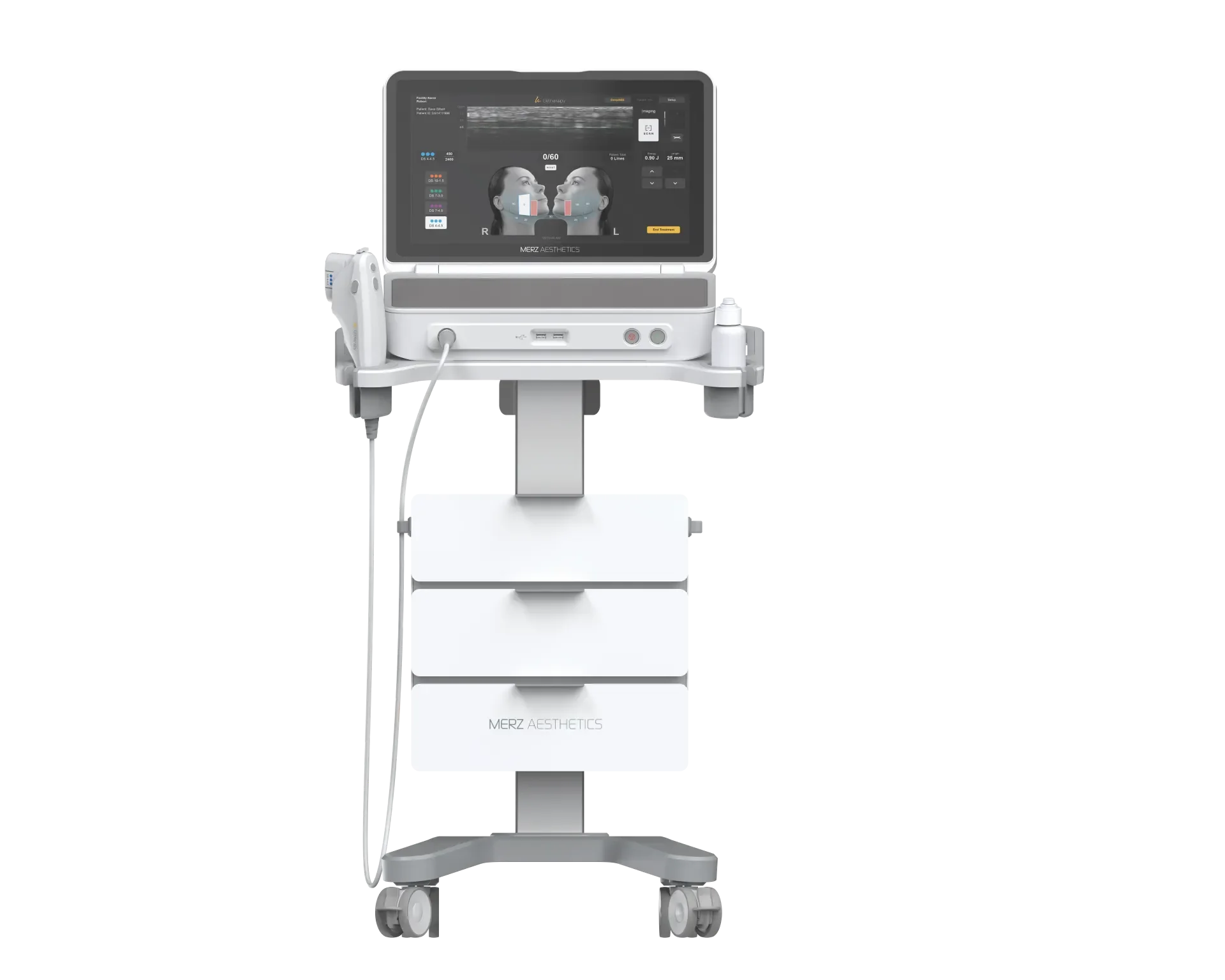
Ultherapy PRIME is the focused-ultrasound tightening platform from Merz Aesthetics, the platform that defines the upper end of the Korean ultrasound tightening market and the one whose provider authorisation is the most consequential single verification an international patient can perform before booking. Korean pricing typically ranges from KRW 1,500,000 to KRW 4,500,000 for face-and-neck protocols, with face-neck-décolleté protocols at the higher end. In USD this corresponds to approximately 1,150 to 3,460. In EUR, approximately 1,065 to 3,190. In JPY, approximately 172,000 to 517,000. In CNY, approximately 8,300 to 25,000. Myeongdong mid-tier pricing sits at the lower band; Gangnam premium pricing sits at the upper band; Incheon Airport-region pricing varies depending on whether the practice is a Seoul-flagship branch operating at parent pricing or a standalone airport clinic. The cross-clinic price variance reflects shot count (300 versus 600 versus 900+), physician seniority, multilingual support depth, and clinic positioning — not platform authenticity. All authorised PRIME providers operate the same Merz Aesthetics device with the same DeepSEE imaging architecture and the same transducer set. The recent PRIME generation, which Merz launched globally over the 2024-2026 window, includes the L1.5-25 transducer for superficial dermal work and the broader visualisation envelope across the device — patients seeking the most current generation should confirm in writing that the clinic operates the PRIME version, not a prior generation.
Thermage FLX — cross-currency price matrix
Thermage FLX is the monopolar radiofrequency tightening platform from Solta Medical, the platform whose dermal collagen-tightening mechanism complements the focused-ultrasound mechanism of Ultherapy and which most Korean senior physicians sequence rather than substitute. Korean pricing typically ranges from KRW 1,800,000 to KRW 4,500,000 for face protocols, with face-and-neck protocols at the higher end and full face-neck-eye protocols (incorporating the Eyes Total Tip) approaching KRW 6,000,000. In USD this corresponds to approximately 1,380 to 3,460, with full eye-inclusive protocols reaching 4,615. In EUR, approximately 1,275 to 3,190, with eye-inclusive reaching 4,255. In JPY, approximately 207,000 to 517,000, with eye-inclusive reaching 690,000. In CNY, approximately 10,000 to 25,000, with eye-inclusive reaching 33,300. Combined Thermage-and-Ultherapy programmes — typically sequenced across two visits with several weeks between to allow the radiofrequency-induced collagen response to mature before the ultrasound layering — commonly run KRW 5,000,000 to KRW 8,000,000 total, or approximately USD 3,850 to 6,150. Pricing variance reflects shot count (the FLX algorithm specifies 600, 900, or 1,200+ shots depending on the protocol), physician seniority, and clinic positioning — not platform authenticity. All authorised Thermage FLX providers operate the same Solta Medical device with the same Total Tip and AccuREP technology.
Sofwave — cross-currency price matrix
Sofwave is the synchronous ultrasound parallel beam platform from Sofwave Medical, the newer tightening device whose mechanism delivers ultrasound energy at a mid-dermal depth distinct from the SMAS-targeting depth of Ultherapy, and whose Korean adoption has accelerated meaningfully across the 2024-2026 window as senior physicians integrate it into the layered-modality repertoire. Korean pricing typically ranges from KRW 1,200,000 to KRW 3,500,000 for face protocols. In USD this corresponds to approximately 920 to 2,690. In EUR, approximately 850 to 2,480. In JPY, approximately 138,000 to 402,000. In CNY, approximately 6,700 to 19,400. Myeongdong mid-tier pricing sits at the lower band; Gangnam premium pricing sits at the upper. The platform's clinical positioning relative to Ultherapy and Thermage is not a substitute but a layered complement — Sofwave's mid-dermal SUPERB (Synchronous Ultrasound Parallel Beam) energy delivery is increasingly programmed alongside Ultherapy's deeper SMAS work and Thermage's volumetric dermal tightening rather than as an either-or choice. The technical detail of the parallel-beam architecture is documented on the Sofwave Medical corporate site and is worth reviewing if the platform mechanism factors into your decision.
Stem cell and regenerative bio-active work — cross-currency price matrix
Regenerative bio-active work — covering exosome series, stem-cell-derived conditioned media protocols, growth-factor cocktails delivered via microneedling or radiofrequency-assisted micro-channelling, and the broader category of regenerative-medicine adjuncts — sits in a distinct pricing tier and follows a session-programme model rather than a single-procedure model. Per-session pricing typically runs KRW 400,000 to KRW 1,500,000, with three-to-five-session programmes commonly KRW 1,500,000 to KRW 5,000,000 total. In USD, per-session approximately 310 to 1,155, with full programmes 1,155 to 3,850. In EUR, per-session approximately 285 to 1,065, with full programmes 1,065 to 3,545. In JPY, per-session approximately 46,000 to 172,000, with full programmes 172,000 to 575,000. In CNY, per-session approximately 2,200 to 8,300, with full programmes 8,300 to 27,800. The wide variance reflects substantial differences across the active itself (single growth factor versus comprehensive exosome cocktail versus conditioned-media supernatant), the delivery vector (basic microneedling versus radiofrequency-assisted micro-channelling versus combined platform-assisted protocols), and clinic positioning. The Korean regulatory framework for advanced regenerative-medicine work runs under the Advanced Regenerative Bio Act administered by the Ministry of Food and Drug Safety, and clinics operating designated advanced regenerative medicine centre status under that framework are positioned differently in the market — that designation is worth confirming in writing when the proposed protocol involves cell-derived bio-actives at meaningful concentration.
Thread lifting — cross-currency price matrix
Thread lifting pricing in Korea typically ranges from KRW 1,500,000 to KRW 6,000,000+ depending on thread count, polymer selection, and clinic positioning. PDO-only protocols often run KRW 1,500,000 to KRW 2,500,000, or approximately USD 1,150 to 1,920, EUR 1,065 to 1,775, JPY 172,000 to 287,000, CNY 8,300 to 13,900. Mixed PDO-PCL or PDO-PLLA protocols often run KRW 3,000,000 to KRW 5,000,000, or approximately USD 2,310 to 3,850, EUR 2,130 to 3,545, JPY 345,000 to 575,000, CNY 16,700 to 27,800. Comprehensive multi-vector premium protocols at the high end reach KRW 5,000,000 to KRW 7,000,000+, or approximately USD 3,850 to 5,385 and beyond. The polymer choice matters technically — PDO (polydioxanone) is the shortest-duration absorbable, PLLA (poly-L-lactic acid) and PCL (polycaprolactone) progressively longer-duration with somewhat different collagen-induction profiles — and the count and vector geometry matter clinically. Cross-currency the relative pricing structure across polymers is consistent across the four currencies tabulated here; the absolute KRW figure is what shifts with rate movement.
Combination programmes and what the matrix obscures
The single-modality price matrix above is necessary for orientation but is not how international patients typically commit. Combination programmes — Ultherapy PRIME plus Thermage FLX plus a regenerative bio-active series plus thread lifting across a five-to-seven-day Seoul trip — commonly total KRW 8,000,000 to KRW 15,000,000 or more, corresponding to approximately USD 6,150 to 11,540, EUR 5,675 to 10,640, JPY 920,000 to 1,725,000, CNY 44,400 to 83,300. Package pricing for such programmes is sometimes negotiable in writing before booking, reflects the comprehensive nature of the programme rather than a discount on individual modalities, and should always be requested itemised so that the patient can compare each component against the standalone references above. The pricing-package discussion is the consultation moment where misunderstanding most reliably occurs across language barriers; the practical answer is to request written itemisation in English (or the patient's working language) with KRW figures, currency-conversion notation, and a clear statement of which components are inclusive and which are add-on. The aftercare guide covers the post-procedure window across these combination programmes; the visa and travel guide covers the operational arrangement of the trip itself.
Frequently asked questions
Why is there so much price variance between clinics in Korea for the same device?
Variance reflects shot count, physician seniority, multilingual support depth, aftercare structure, and clinic positioning rather than platform authenticity — all authorised platform providers operate the same manufacturer device with the same technical specification. The honest read is that you are paying for consultation depth and post-procedure structure as much as for the treatment itself. The matrix on this page is necessary orientation but should always be confirmed against written clinic-specific quotation.
Which currency should I plan in if I am travelling from Europe or North America?
Plan in your home currency for budgeting purposes and convert via the matrix above for orientation, but always confirm the final figure in KRW because that is what the Korean clinic will quote and charge. When the charge comes through, decline Dynamic Currency Conversion at point-of-sale and let your card issuer convert at home-currency rates, which typically saves 2-4% versus Korean terminal conversion.
How accurate are the conversion rates on this page over time?
The conversions on this page are calculated at the rates current at last review (2026-05-10). Exchange rates fluctuate daily, sometimes by several percentage points across a quarter. The page is updated on a quarterly cadence, but international patients should re-verify against current mid-market rates before booking; a several-percent movement in the USD-KRW or EUR-KRW pair is not unusual and can shift the practical total cost meaningfully on a combination programme.
Are package programmes that combine multiple modalities cheaper than booking modalities individually?
Sometimes, modestly. Package pricing reflects the comprehensive nature of the programme and the operational efficiency of treating the patient across a single trip; it does not generally reflect a meaningful discount on the manufacturer device cost or on the senior physician fee. The 5-15% range of package versus itemised pricing is typical; international patients should always request the itemised pricing alongside the package figure so the comparison is explicit.
What is the relationship between platform-authorised pricing and the device authenticity question?
The Korean market has historically had counterfeit-device concerns for the high-volume ultrasound platforms, and the manufacturer provider locator is the operationally useful verification mechanism. Authorised providers tend to price within the matrix bands above; pricing meaningfully below the lower band — particularly for Ultherapy PRIME — is one signal worth checking against the Merz provider locator, the Solta Medical provider locator, and the Sofwave Medical corporate site directly before committing.
Is the regenerative bio-active pricing typical of the Korean market or specific to designated advanced regenerative medicine centres?
The session-programme pricing band above is typical of the broader Korean market for exosome and growth-factor work delivered through aesthetic clinics. Designated advanced regenerative medicine centre status under the Ministry of Food and Drug Safety advanced regenerative bio framework is a separate operational designation that applies to a smaller subset of facilities and that typically prices at the upper band of the matrix or above; it is worth confirming in writing when the proposed protocol involves cell-derived bio-actives at meaningful concentration rather than supernatant-only or growth-factor-only preparations.
How does the Korean pricing matrix compare with prices in Hong Kong, Singapore, the United States, or the United Kingdom?
Korean prices for branded ultrasound and radiofrequency platforms are typically 30-60% below comparable treatment in Hong Kong or Singapore, 50-70% below the United States or United Kingdom, and broadly comparable to Japan. The differential reflects cost structure (physician overhead, real-estate cost, ancillary staffing) and market competition (Korea has unusually high clinic density). The thread-lifting and regenerative bio-active categories have a narrower differential because the manufacturer-device cost component is a smaller share of total pricing.
Where can I see the operational mechanics of the trip itself — visa, transfer, aftercare — alongside this pricing matrix?
The pricing guide covers the operational mechanics of payment and currency conversion in more detail. The visa and travel guide covers the operational arrangement of the trip itself, including Korea Health Industry Development Institute medical visa pathways. The aftercare guide covers the post-procedure window. For the broader 2026 Korean market context that situates this matrix, see the market trends piece and the Visit Korea Medical regional comparison hub.