Treatment Guide
MFU technology generations, and the Ulthera / Liftera / Doublo question
An engineering-first read of microfocused ultrasound — what changed across MFU generations, why the platform shortlist in Korea narrowed to three categories, and how to compare them honestly.
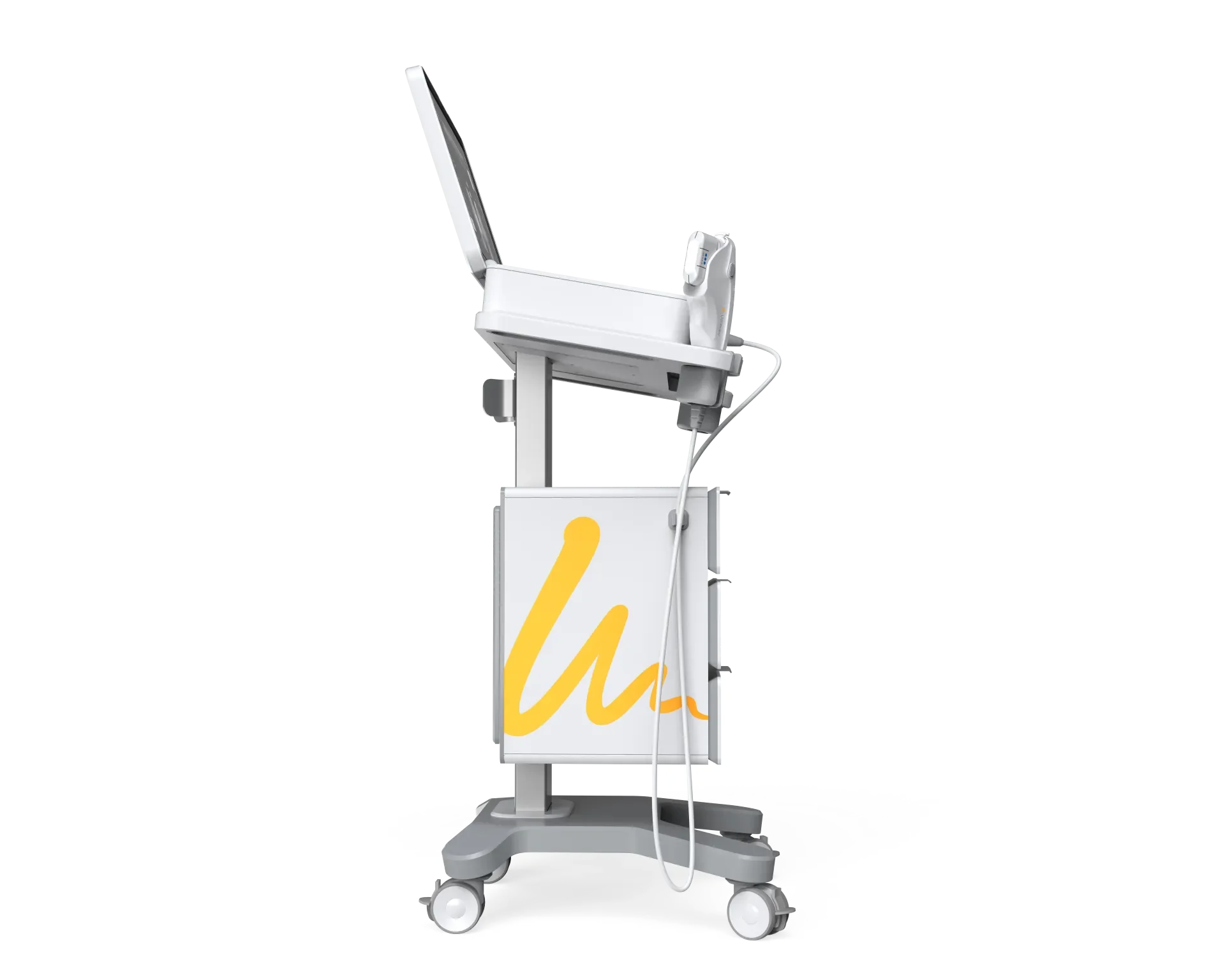
Microfocused ultrasound is the most over-described and under-explained lifting modality in Korean aesthetic medicine. Marketing copy from clinics, manufacturers, and aggregator sites tends to flatten the category into a single sentence — focused ultrasound stimulates collagen — and attach whatever branded platform the clinic happens to operate. The deeper truth is that MFU is a technology category with meaningful engineering generations, materially different transducer architectures, and a small handful of platforms that dominate the Korean clinical landscape for partly clinical, partly regulatory, and partly commercial reasons. This deep-dive page exists to do the work that consumer-facing marketing does not: read the generations against each other, explain what changed engineering-wise, and compare the three platforms most Korean patients are actually offered — Ulthera (and its current Ulthera Prime generation), Liftera (Classys), and Doublo (Hironic) — in terms that map back to what happens during a single in-room session. For the broader categorical orientation, see our MFU and HIFU lifting overview; for platform-specific Ulthera Prime coverage, see the Ulthera Prime guide. Authoritative manufacturer and regulatory context is available through Merz Aesthetics, the Korean Society of Dermatology, and the Korean Ministry of Food and Drug Safety.
MFU as an engineering category, not a single device
Microfocused ultrasound is, at the engineering level, a small family of transducer-driven thermal-coagulation systems that deliver ultrasonic energy to discrete focal points beneath the skin surface. The category is defined by three engineering decisions: the operating frequency of the transducer (typically 4 MHz, 7 MHz, or 10 MHz), the focal depth selectable at the handpiece (most commonly 1.5 mm, 3.0 mm, and 4.5 mm), and the energy-delivery pattern at the focal point. Different platforms make different decisions across these three axes, and the decisions matter clinically: a 4 MHz transducer reaching 4.5 mm targets the superficial musculoaponeurotic system (SMAS) where structural lifting is generated, whereas a 7 MHz or 10 MHz transducer reaching 1.5 mm or 3.0 mm targets dermal and subcutaneous tightening. Every serious MFU platform operates at multiple depths because no single depth addresses the full lifting problem; the question for the patient is which platform's engineering decisions match the anatomy and goal at hand.
Generations within the Ulthera family
Ulthera (Merz Aesthetics) is the regulatory benchmark platform and has gone through three meaningful generations in clinical service. The original DeepSEE generation, introduced in 2009, operated with a fixed transducer set and a manually advanced shot pattern; treatment times for a full face-and-neck protocol commonly ran 90 to 120 minutes, and patient-tolerance limits often forced shot-count compromises. The DeepSEE-Plus generation in the mid-2010s introduced a redesigned handpiece, faster shot delivery, and a wider transducer set including 10 MHz dermal options, cutting full-face-and-neck times to 60 to 75 minutes and improving tolerability at SMAS depth. The current Ulthera Prime generation, introduced in Korea in 2021 and widely adopted by 2023, runs on a refactored platform: a higher-resolution real-time ultrasound visualisation interface lets the operator confirm transducer placement against the actual SMAS plane, an updated pulse architecture reduces the sharpness of the sensation peak, and the platform is cleared for décolleté treatment in addition to face and neck. Patients who received the older DeepSEE generation and then receive Ulthera Prime typically describe the Prime experience as faster, less painful at peak, and more controllable; clinicians report a meaningful reduction in shot-count compromise driven by patient intolerance.
Liftera and the Classys design philosophy
Liftera (Classys) is the leading Korean-engineered MFU platform and represents a different engineering philosophy from the Ulthera family. Where Ulthera uses discrete shot delivery — one focal-point coagulation per trigger pull — Liftera uses a moving-handpiece pattern where the transducer translates continuously across the skin surface delivering a series of focal points along a linear path. The clinical effect is that Liftera produces line counts rather than shot counts; a face-and-neck protocol is described in terms of how many lines are delivered at each depth. This changes what comparable means across platforms: a 600-shot Ulthera Prime protocol is not directly comparable to a 600-line Liftera protocol, and reading one as a substitute for the other requires understanding the focal-point density per line. Liftera's tolerability is generally rated higher than older Ulthera generations because the moving-handpiece delivery feels less punctate; the structural-lift outcome in skilled hands is closer to Ulthera Prime than the price gap suggests. Classys also operates the broader Ultraformer III and Ultraformer MPT platforms, which extend the linear-translation philosophy with different depth options.
Doublo and the Hironic shot-count platform
Doublo (Hironic) is the third platform Korean patients are most commonly offered, and its engineering decisions sit closer to Ulthera than to Liftera. Doublo is a discrete-shot platform — one focal-point coagulation per trigger pull — but with a shot-delivery architecture that prices materially below Ulthera. The current Doublo Gold generation includes a wider transducer set, an updated pulse pattern, and improved tolerability over the original Doublo. The honest technical read is that Doublo Gold in skilled hands and on a well-maintained device can deliver clinical results closer to Ulthera Prime than the marketing-positioning of Ulthera versus generic HIFU suggests; the honest commercial read is that Doublo's lower price point reflects lower manufacturer cost, lower transducer-replacement cost, and a domestic-Korean device-supply chain that does not carry the import and licensing costs of Merz-imported transducers. The platform's biggest weakness is not engineering; it is the gap between authorised, well-maintained Doublo installations at high-volume Korean clinics and lower-tier installations where transducer maintenance is less rigorous. The same caveat applies to Ulthera at the bottom of the market, but Merz's authorised-provider list provides a partial filter that Hironic's distribution does not.
Reading the three platforms against each other
If a Korean clinic offers Ulthera Prime, Liftera, and Doublo on the same menu — and many Gangnam and Myeongdong clinics do — the practical comparison reduces to four questions. First, where in the engineering tree does each platform sit, and does that match what the patient anatomically needs? An SMAS-dominant lifting problem favours the platforms with the most precise 4.5 mm targeting (Ulthera Prime, Liftera at deeper-line settings). A dermal-tightening problem with little structural lift required favours platforms with strong 1.5 mm and 3.0 mm options. Second, what is the maintenance state of the actual unit in the clinic? Manufacturer-authorised maintenance schedules differ; clinics that operate at high patient volume cycle transducers more rapidly than low-volume clinics. Third, what is the operator experience on the specific platform? A senior practitioner with 10 years on Liftera and 1 year on Ulthera Prime may produce a materially better Liftera result than Ulthera Prime result, even though Ulthera Prime is the more expensive platform. Fourth, what is the patient paying for and what assurance does the patient have? A patient paying premium-tier Ulthera Prime pricing is paying for manufacturer authorisation and transducer authenticity verifiable through the Merz Aesthetics provider locator, under FDA and MFDS clearance. A patient paying lower-tier Doublo pricing is paying for clinical outcome alone, with accountability framed at the level of MFDS device clearance rather than manufacturer authorisation. Both can produce excellent results in the right setting; the patient's decision should be informed rather than defaulted. For deeper Ulthera Prime coverage we operate a specialist archive at gangnam-ultherapy-prime.com, and for the Myeongdong-specific Ultherapy practice landscape, myeongdong-ultherapy.com carries the regional editorial coverage.
What the comparison does not capture
A platform-comparison frame misses three things that matter at least as much as the platform itself. First, candidate selection: patients with moderate skin laxity respond well to any of the three platforms in skilled hands; patients with severe laxity respond poorly to all three and should be evaluated for surgical alternatives rather than upgraded to a more expensive non-surgical platform. Second, protocol design: where in the face the shots or lines are placed matters more than how many of them there are. A 500-shot protocol designed for upper-face lifting in a patient whose primary concern is jowl descent will under-deliver compared to an 800-shot protocol with proper mid-face and jowl distribution. Third, sequencing: MFU is rarely the only modality in a comprehensive programme. Patients commonly combine MFU with radiofrequency tightening, with regenerative work, and with thread lifting in a sequenced trip structure. The platform comparison answers part of the question; protocol and sequencing answer the rest. For the broader discussion see our treatments overview and pricing context; the aftercare guide covers the post-procedure window across modalities.
Frequently asked questions
Is Ulthera Prime always the best MFU option in Korea?
No. Ulthera Prime is the most regulatorily-anchored platform and the one with the strongest manufacturer-authorisation framework, but in skilled hands on a well-maintained device, Liftera and Doublo Gold can produce clinical results closer to Ulthera Prime than the marketing gap suggests. The honest answer depends on candidate anatomy, the specific clinic's platform maintenance, the operator's experience on the specific platform, and the patient's tolerance for the price-versus-assurance trade-off.
What is the difference between Liftera shots and Ulthera shots?
Different units. Liftera is priced and protocoled in line counts because its transducer translates continuously along a path delivering a series of focal points. Ulthera is priced and protocoled in shot counts because each trigger pull delivers a single focal-point coagulation. A 600-line Liftera protocol is not directly comparable to a 600-shot Ulthera Prime protocol; comparable density depends on the underlying focal-point spacing along each Liftera line.
Is Doublo just a cheap copy of Ulthera?
No. Doublo is a separately engineered platform from Hironic with its own transducer architecture, pulse pattern, and clinical clearance under the Korean Ministry of Food and Drug Safety framework. It is priced lower than Ulthera Prime because the manufacturer cost structure is lower (no foreign import, no Merz licensing premium), not because it is a derivative or counterfeit device. The clinical-outcome gap between well-maintained Doublo Gold and well-maintained Ulthera Prime in skilled hands is narrower than the price gap suggests.
How do I verify a Korean clinic operates an authentic Ulthera Prime device?
The Merz Aesthetics provider locator publishes the authorised-provider list internationally. The Korean Ministry of Food and Drug Safety also maintains device-registration records under the Class II medical-device framework. For Liftera and Doublo, MFDS registration is the primary public verification because neither Classys nor Hironic operates a public authorised-provider list comparable to Merz's.
Can I expect different downtime across the three platforms?
Functionally no. All three are zero-downtime platforms with mild erythema for a few hours, occasional transient swelling, and a low probability of mild bruising at high-energy zones. There are no incisions, no general anaesthesia, and no enforced rest period. The sensation profile during treatment differs — Liftera is generally rated more tolerable than Ulthera Prime, which is generally rated more tolerable than older DeepSEE-generation Ulthera devices — but the post-treatment experience is broadly comparable.
Which platform combines best with Thermage FLX?
All three combine clinically. The sequencing question is more important than the platform-choice question: most senior Korean practitioners separate MFU and Thermage FLX by two to four weeks rather than running them in the same session, because the inflammatory response curves overlap and stacking them produces more swelling than a sequenced approach. Where same-trip treatment is logistically necessary, MFU first and Thermage FLX 7 to 10 days later is a common pattern; platform choice does not materially change this.
Are there MFU platforms I should avoid in Korea?
Not by platform name, but by maintenance state. The variation from a poorly maintained instance of any of the three platforms — including Ulthera Prime — is larger than the variation between well-maintained instances. Ask the clinic how recently transducers were last replaced and whether the device is on the manufacturer's authorised maintenance schedule. Clinics that answer easily are the ones to consult; clinics that deflect are the ones to avoid.