Treatment Guide
Ultherapy PRIME in Korea
The current Merz Aesthetics platform, how Korean clinics protocol it, and what an international patient should expect from a single session.
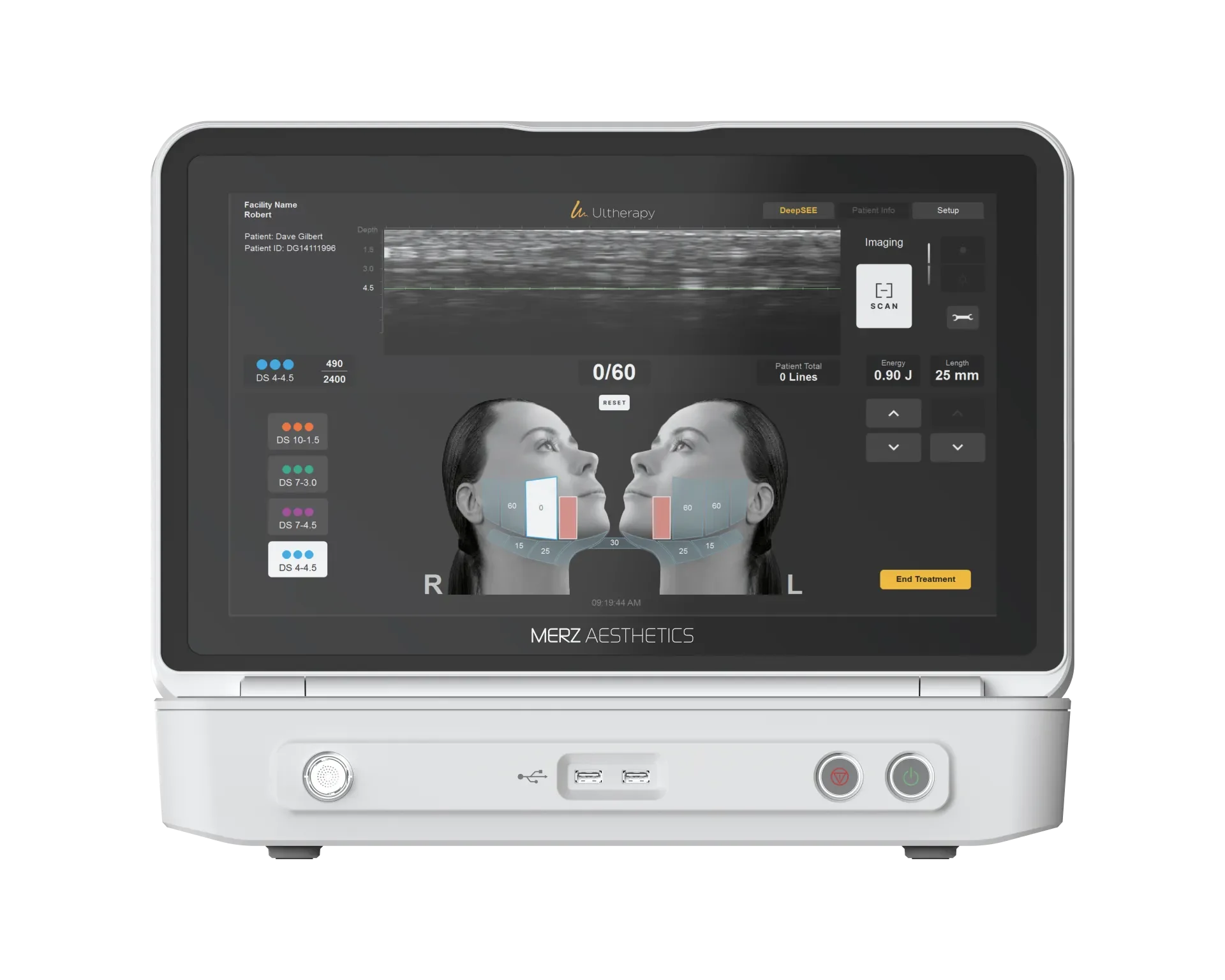
Ultherapy PRIME is the current generation of Merz Aesthetics' microfocused-ultrasound (MFU) platform, cleared for non-surgical lifting of the brow, submental area, neck, and — newly with the PRIME generation — the décolleté. The platform delivers focused ultrasound energy to discrete coagulation points at three depths — typically 1.5 mm, 3.0 mm, and 4.5 mm — corresponding to the dermis, subcutaneous fat, and SMAS. The thermal-coagulation injury pattern triggers a remodelling response: collagen denatures and reorganises, and the patient's lift develops gradually over three to six months. Korea is one of the highest-volume markets for Ultherapy and Ultherapy PRIME globally; the better clinics in Gangnam, Myeongdong, and Incheon Airport have protocoled the platform across thousands of international patients. We cover the platform here at the level of patient-facing orientation; for deeper editorial coverage of named clinics, see the dedicated Ultherapy PRIME archive for Gangnam-specific practice and our regional archives for Myeongdong, Incheon Airport, Seoul, and Korea-wide context.
What Ultherapy PRIME does, and what it does not
Ultherapy PRIME's clinical lane is moderate skin laxity in patients who want a structural lift — the kind of lift that surgery would deliver more decisively, but at lower cost, lower risk, and zero downtime. Suitable candidates have moderate brow descent, mild-to-moderate jowl formation, and submental laxity without dramatic platysmal banding. The platform is not a substitute for facelift surgery in patients with substantial structural sag; it is also not the right tool for skin-quality concerns where the underlying issue is texture or tone rather than laxity. The PRIME generation is faster than the older DeepSEE generation, generally better tolerated, and capable of treating the décolleté — an addition over the previous platform. The lifting effect peaks at three to six months and persists for twelve to eighteen months in most patients; many international patients return for maintenance treatment annually. The Merz Aesthetics provider locator is the authoritative reference for verifying that a Korean clinic operates an authentic Ultherapy or Ultherapy PRIME platform.
Shot count, depth, and protocol selection
Korean clinics typically protocol Ultherapy PRIME on a shot-count basis. A face-and-neck protocol commonly runs 600 to 900 shots distributed across the three depths, with the heaviest concentration at the 4.5 mm SMAS depth where the structural lift is generated. A more comprehensive face-neck-décolleté protocol can run 800 to 1,200 shots. The protocol the consulting physician proposes should be calibrated to the patient's anatomy: a brow-dominant pattern for patients whose primary concern is upper-face descent, a mid-face-and-jowl pattern for patients with lower-face laxity, a submental-and-neck pattern for patients whose photographic concern is profile rather than frontal. Shot count alone is not a quality marker — distribution and depth selection matter at least as much. The better Korean clinics will photo-document the planned shot map at consultation and review it with the patient before treatment begins; less rigorous practices will quote a single shot count without distributional detail.
Discomfort, downtime, and the realistic experience
Ultherapy PRIME is not painless. The thermal-coagulation points at the 4.5 mm SMAS depth, in particular, are intense — patients describe brief sharp sensation, often accompanied by an audible click and a fleeting wave of warmth. Korean clinics generally manage this with topical anaesthesia applied for 30 to 45 minutes prior to treatment, sometimes supplemented with oral analgesia or — in patients with high anxiety — a light intravenous sedation. The PRIME generation is meaningfully more tolerable than the older DeepSEE generation due to the modified handpiece and pulse pattern, but it remains a sensation-rich treatment. Downtime is functionally zero for most patients: mild erythema for a few hours, occasional transient swelling at SMAS-level coagulation points, and a small probability of mild bruising at the submental area. Patients commonly attend dinner the same evening. The lifting result is not visible at day one; it develops over weeks as the collagen remodelling response matures.
How the result reads, and how to evaluate it honestly
Ultherapy PRIME's lifting effect is, at its best, subtle — the kind of result that registers as 'looking well-rested' rather than as a visibly different face. Patients who expect surgical-level transformation are reliably disappointed; patients who expect a careful, slow-developing tightening of the lower face and a gentle elevation of the brow typically read the result as worthwhile. The honest editorial framing is that Ultherapy PRIME buys a patient three to five years' worth of lifting in a single session — useful as a non-surgical alternative for patients not yet ready to consider surgery, and useful as an adjunct to surgical or other non-surgical work in patients who already are. Photographic documentation at baseline and at three months is the only reliable way to evaluate one's own response; before-and-after photographs from the clinic should be read as illustrative, not predictive. Studies suggest patient satisfaction correlates more closely with appropriate candidate selection and physician technique than with shot count or generation of platform.
Korean pricing context and where to consult
Ultherapy PRIME pricing in Korea typically ranges from KRW 1,500,000 to KRW 4,500,000 for a face-and-neck protocol, with face-neck-décolleté protocols at the higher end. Myeongdong clinics often run lower than Gangnam premium clinics; Incheon Airport pricing varies. The price difference is a function of shot count, physician seniority, multilingual support, and clinic positioning rather than platform authenticity — all authorised Ultherapy PRIME providers operate the same Merz device. International patients in Korea can usually consult and treat in a single trip; consultation in the morning, treatment same-day or next-day, is a typical structure for patients arriving from Hong Kong, Singapore, Taiwan, or Japan. For deeper editorial coverage of named Korean clinics offering Ultherapy PRIME, see our Gangnam region archive, Myeongdong region archive, and Incheon Airport region archive — each links out to the specialised Ultherapy publisher archive operated alongside this directory.
Frequently asked questions
What is the difference between Ultherapy and Ultherapy PRIME?
Ultherapy PRIME is the current generation Merz Aesthetics platform, replacing the older DeepSEE generation. PRIME is faster, generally better tolerated, and capable of treating the décolleté in addition to the face and neck. The clinical mechanism is the same: focused-ultrasound thermal coagulation at multiple depths.
How long does the result last?
The lift develops over three to six months as collagen remodelling matures and persists for twelve to eighteen months in most patients. Many international patients schedule maintenance treatment annually; some clinics recommend a top-up at six months in patients with rapid laxity progression.
Is Ultherapy PRIME painful?
It is sensation-rich rather than uniformly painful. The 4.5 mm SMAS-depth shots are the most intense; topical anaesthesia for 30 to 45 minutes prior to treatment is standard, with oral analgesia or light IV sedation available for patients with high anxiety. The PRIME generation is more tolerable than the older DeepSEE generation.
Can I combine Ultherapy PRIME with other treatments in the same trip?
Yes. Common combinations include Ultherapy PRIME with regenerative work (exosome or growth-factor boosters) on a different day, or Ultherapy PRIME with Thermage FLX in a sequenced programme spaced by several weeks. Korean physicians generally space modalities by at least 48 to 72 hours, which a five-to-seven-day Seoul trip accommodates.
How do I verify a Korean clinic actually operates an authentic Ultherapy PRIME?
The Merz Aesthetics provider locator at ulthera.com publishes the authorised-provider list. We cross-check clinic claims against this list before publishing editorial coverage; readers can independently verify.
What should I avoid post-treatment?
Vigorous facial massage for 7 to 10 days, sauna or hot yoga for 3 to 5 days, and direct sun without SPF 50+ for 14 days. Most clinics provide written aftercare in the patient's working language; international-patient coordinators commonly handle questions over WhatsApp, LINE, or WeChat for the first two weeks.